THE RUSSIAN DEFENSIVE PLAN
In August 1936 Moscow became involved in the Spanish Civil war to further the cause of the Republicans and by October the Soviets were sending weaponry and military personnel to the peninsula. Stalin sent the most advanced military equipment at his disposal and Soviet troops soon faced the German Condor Legion that was supporting the Nationalists. It was the beginning of a proxy war fought between the two adversaries and Stalin stepped up his measures for a future confrontation with Germany. His second five-year plan (1933-1937) was already in full swing for the benefit of the RKKA (Raboche-krest'yanskaya Krasnaya armiya), literally Workers' and Peasants' Red Army, which was already the largest military force in Europe. The Spanish war would allow the Soviets to test weapons and fine tune tactics.
All armies have high command staffs whose function is to prepare plans for every eventuality and the Red Army devised defensive and offensive plans that they updated periodically. A war in Europe between the Capitalist States appeared very probably as early as 1935 and the Russians prepared methodically.
By 1941 a highly developed defensive plan, named DP-41 was in existence. One key feature of this blueprint is that the Soviet Supreme Command designed it to defeat an invasion in two fronts simultaneously: against Germany from the West and against Japan from the East. The Soviet High Command projected an attacking force consisting of 270 divisions: 233 in the main European front and 37 in the Far East. They assumed that the Germans would launch the invasion with the support of Italian, Finish, Rumanian and Hungarian forces while the Japanese attacked from Asia. Given the size of the adversaries’ military forces and the location of the Soviet Union industrial areas, they recognized that the most important threat came from the West. The noteworthy quality of DP-41 is that the Red Army Staff planned against a worst-case scenario, eschewing any wishful thinking.
The Russians established that to defeat the Western invasion, a force of at least 171 divisions in 3 defensive belts (57 in the first belt, 52 in the second belt and 62 in the third) was necessary . Thus, they expected an enemy’s numerical superiority of 233-to-171 or 36%, but Soviet Generals recognized that defense has an advantage over offense and hence, they judged such force sufficient to defeat an invader.
Based on the experience of the Great War, the Russians assumed grievous fatalities, anticipating the loss of their entire deployed forces every 4 to 8 months of fighting and the need to replace them. To restore the strength of these depleted formations with such an appalling casualty rate, they proceeded to amass sufficient weapon stocks, instruct sufficient reserves and to gear up their military industrial complex and military school training system. This they did, through a process that took 10 years to complete, giving DP-41 a very robust foundation. This is a compelling evidence of two qualities from Stalin’s communist government: ability to think with clarity in the longer term and aptitude to execute wide-ranging plans that demand a National effort.
By analyzing the geography of the threatened sectors, the Soviets realized that the Pripet Marshes divided the front in a northern and southern sector preventing a connected defense. The Pripet Marshes is a large region of wetlands, approximately 480 km east-to-west and 225 km north-to-south situated in Southern Belarus and Northwest Ukraine. The area is, for practical purposes, impassable for large military forces.

(Source: Ramsar Convention of Wetlands)
It is heavily wooded and it has few roads, but these are not the main factors that preclude large-scale mobility. Rather, it is the large swamps, ponds and rivers interspersed through this region that make the movement of heavy vehicles exceedingly difficult. Even under the best conditions, crossing this area on foot or horse is problematic due to soggy ground. Melting snow and rainfall cause extensive flooding that convert the terrain into near impenetrable ground.
Words sometimes are insufficient to convey the difficulty of this region to movement because the average reader usually drives through well paved roads or at most using dry dirt trails. But off-road enthusiasts are aware of how even well-equipped 4x4 vehicles cannot traverse through many areas. The picture above, does an excellent job in showing the hard going this terrain entails.
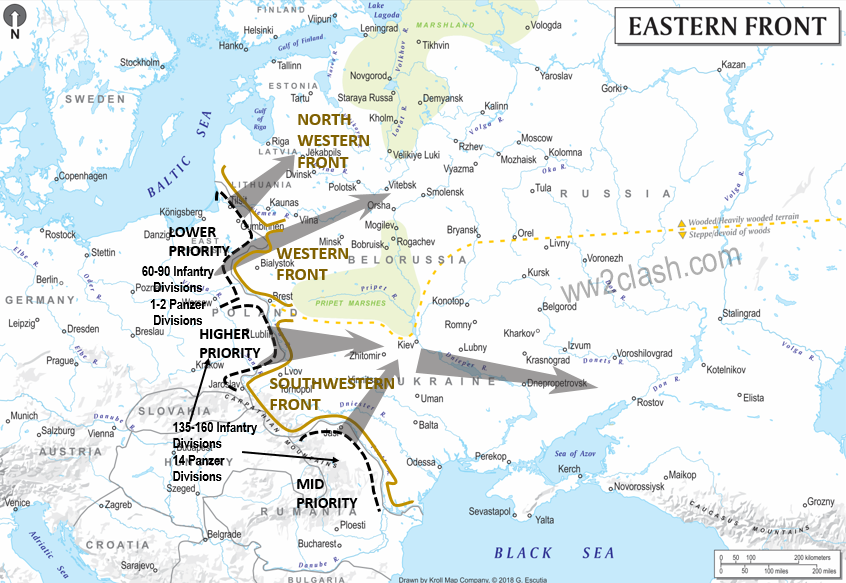
This great obstacle separates an assaulting army in two and the invader therefore must decide if his main effort should fell north or south of the marshes. After prolonged discussions, the Russians decided that the Germans would direct their main effort to the south. They expected a direct advance on Kiev from Krakow with a converging secondary prong from Rumania (see Plan Assumptions Map). The estimated magnitude of this southern offensive stood at 14 panzer divisions supported with 135 to 160 infantry divisions. To give some perspective, this projected southern force was larger than all the forces utilized by the Germans to invade France in 1940. In addition, in the northern sector, they expected another 60 to 90 infantry divisions stiffened with 1 or 2 Panzer divisions to launch a secondary two-prong attack: From Konigsberg to the Baltic States and from Warsaw to Minsk and Smolensk.
The proper determination of the enemy’s main point of effort is so critical, that there was much debate. Alexander Vasilevskiy, deputy Chief of Staff at the time, envisaged the main thrust north of the Pripet marshes.
However, ultimately, the plan supported the southern hypothesis, based on the views of Stalin and Georgi Zhukov. There were good reasons for that. The clear terrain in the south was very favorable for tank operations and did not offer concealment to the defender, in contrast with the wooded terrain in the north (see the line of demarcation between wooded and non-wooded areas in the map). Moreover, the indispensable oil fields in the Caucasus were in the south, as well as other key strategic sources of food and raw materials throughout the Ukraine.
To defend against this threat the Red Army deployed 220 divisions in the western border districts on the eve of the German offensive: 163 of them in three successive defensive belts and a further 57 divisions in operational reserve (see Deployment Map). This force exceeded substantially the 171 divisions that DP-41 estimated to be the minimum necessary to defeat the German onslaught. The actual committed strength was 29% more powerful than originally planned, giving the Soviet High Command reasons for confidence.
The Order of Battle that the Russians arrayed was certainly, formidable:
3 Army Groups (called Fronts), 21 armies, 77 corps and 220 divisions. 75 of these divisions, a third, were tank or mechanized divisions, 139 were rifle divisions and 6 were cavalry, all deployed in the western districts and as Stavka reserve. Notably there were also 16 parachute brigades comprising 5 airborne corps. This force structure amounted to 3.310.649 men, 15.470 tanks, 35.508 artillery pieces (including AA guns) and 10.869 aircraft.
The whole Red Army, counting the formations in the Far East and around the rest of the country, numbered 5.104.000 soldiers in the ground Army and Air Force (476.000 in the VVS) organized in 304 divisions, with 23.295 tanks, 19.093 combat aircraft, 48.247 artillery pieces (calibers between 45-305mm), 8.600 AA guns (between 25-85mm), 56.100 mortars (between 50-120mm), and 272.600 motor vehicles of all types. The Far East forces alone, defending against a possible Japanese attack, consisted of 4 armies, 23 divisions, 500.000 men, 3.200 tanks and 4.100 combat aircraft, under General Eremenko.
This huge army was the largest and best equipped force in the world. The VVS (Voyenno Vozdushnye Sili) was numerically the strongest air force in the globe by a wide margin. The size of the land army, including reserves, was unsurpassed by any other power throughout the entire war.22 June 1941
| Type | Army | Stavka | Total |
| Fronts | Reserve | ||
| Army Grp | 3 | 0 | 3 |
| Armies | 15 | 6 | 21 |
| Corps | 60 | 19 | 79 |
| Rifle Corps | 32 | 14 | 46 |
| Mech Corps | 20 | 5 | 25 |
| Cav Corps | 3 | 0 | 3 |
| Abn Corps | 5 | 0 | 5 |
| Divisions | 163 | 57 | 220 |
| Rifle Div | 97 | 42 | 139 |
| Tank Corps | 40 | 10 | 50 |
| Mech Div | 20 | 5 | 25 |
| Cav Div | 6 | 0 | 6 |
| Brigades | 18 | 0 | 18 |
| Rif Bde | 2 | 0 | 2 |
| Abn Bde | 16 | 0 | 16 |
| Regimens | 20 | 5 | 25 |
| Mot Reg | 20 | 5 | 25 |
| Fortified Region | 14 | 0 | 41 |
| Red Army force in | Western Districs |
| Men | 3,310,649 |
| Tanks | 15,470 |
| Vehicles | 173,137 |
| Artillery Pieces | 35,508 |
| Mortars | 29,063 |
| Aircraft | 10,869 |
Furthermore, the army gained experience in Spain and had the opportunity to prove itself in battle recently. In 1939 it invaded Poland, testing its operational mobility, and fought wars against Japan and Finland. Its performance was weak on the attack, but it demonstrated toughness and resilience on the defense. Neither Japan nor Finland proved capable of piercing the Soviet lines at operational depth and the red air force gained local air superiority in both cases. Feebly against the Finish and convincingly against the Japanese.
This strong defense allowed to tip the scales in the Red Army’s favor when it eventually brought to bear its numerical superiority to swamp the adversaries. Just like the Wehrmacht did after the invasion of Poland and France, the RKKA studied its operative mistakes and took corrective action. Similarly, it studied German successes and adopted some of their principles and prepared countermeasures.
In case of attack, the Russians were confident they would stop the invaders west of the Dnieper river. They started rearming before Germany and enjoyed more time to train, equip and organize their army.
A deeper penetration was difficult due to the limited road network and the railroad track width, unsuitable for German rolling stock. Since contemporary armies were mainly dependent on the rail networks for supply and in all the Soviet Union only 82.000 km (51.000 miles) of track was available, the more the invaders advanced the greater the difficulties to keep their armies supplied.
This lofty confidence continued even on the day the Germans finally attacked: The Soviet High Command ordered their troops to destroy the invaders but not to cross the frontier!
RKKA’s deployment in Western Europe had defensive and offensive characteristics. Defensively, each of the armies protecting the border arranged their rifle divisions close to the frontier; each division guarding 35 km (22 miles) sectors on average. Commanders took maximum advantage of rivers, placing the rifle divisions behind them, thus reducing surprise and mobility potential of the German army.
A WWII division could repel attacks defending a 10km sector or it could fight a delaying action (exchanging space for time) screening a 20km sector, hence, by selecting to thinly defend the border it was not possible to prevent the German army from finding meagerly defended areas and penetrate them, even considering that numerous fortified regions bolstered defense lines in all districts.
However, each Soviet army deployed at least one mechanized corps and sometimes two, behind the rifle corps as tactical reserve to launch vigorous counterattacks that had the objective of stopping the German advance. These mechanized corps, plentifully equipped, had enough tanks in this second echelon to unambiguously outnumber the opposing Panzergruppen in quantity and quality.

Behind the mechanized corps, the Border military districts positioned their operational reserves in a third echelon to allow the creation of new defensive lines in the rear if things were not turning out as planned or to launch heavy counterstrokes forcing the Germans on the defense.
Finally, Stavka prepared a fourth echelon with strategic reserves behind the operational reserves with the intention of hurling them at the appropriate moment and force the Germans to retreat. These two additional echelons by themselves were also more numerous than all the tanks of their opponents .
The Soviet high command knew the importance of achieving air superiority over the battlefield and supported each military district with one air army, composed of several air divisions. These powerful air armies fielded 6.890 aircraft making them numerically as strong as or stronger than the Luftflotten each faced and had a reserve of almost 100% (6.636 aircraft in the interior districts, home defense and long-range aviation but excluding the 4.100 aircraft in the Far East and naval aviation).
Lastly, a vast pool of trained reservists remained available, unassigned to combat units but prepared to form new formations.
In the Southwestern front, where Stavka expected the Wehrmacht maximum effort, the defenders arrayed in even greater depth and with greater troop density; each division covering 24 km (15 miles) sectors. The 5th and 6th armies, defending the most vulnerable areas disposed their corps in 3 echelons, while powerful district reserves stood behind buttressing these defensive belts. Moreover, 3 armies and a mechanized corps from the strategic reserve waited close to the Dnieper River.
Overall on 22 June 1941, only around 25% of the available red divisions shielded the border. The rest, three quarters of the force, provided depth and resilience to the defense: one countermeasure devised to counteract the blitzkrieg. By the time the Germans attacked the first belt, the successive echelons would enjoy forewarning.
The red army positioning, remarkably, exhibited several clear offensive features:
• Significant forces remained well forward in all sectors, threatening the German territories. The powerful 10th army, poised nearest to Berlin was particularly menacing (from the border to Berlin is the same distance than from the frontier to Smolensk). However, this location, semi surrounded by enemy territory was vulnerable to attack. The campaign in Poland showed the risk of facilitating German encirclements by faulty forward deployment and the Soviets, after analyzing that campaign, probably recognized it, but chose to do it regardless, for some reason.
• The strongest mechanized corps were close to the border, in the second echelon: 3rd MC (Baltic District), 6th MC, (Western District), and 4th MC (Kiev District). This allowed the launching of offensives towards enemy vulnerable sectors (East Prussia, Poznan and Krakow).
• The Baltic, Western and Kiev Military districts controlled one airborne corps each. Paratroops exists as offensive troops meant to attack behind enemy lines to support mechanized offensive drives. If the Red Army was not contemplating an offensive, their place was in the rear, as Stavka reserve, not forward.
• Another strong mechanized corps (the 2nd MC) supported by one airborne corps was in Rumania threatening the Rumanian oilfields.
• The Russians constructed, at significant effort, an impressive number of airfields near the border and then filled them to the brim with combat aircraft. These locations make sense if the RKKA was preparing an offensive and needed to penetrate hostile airspace, otherwise, they become highly vulnerable to attack. For security, air bases farther from the front are sensible because they can still protect their ground armies and they enjoy more time to respond to the hazard of incoming aircraft. The previous year, the British found that their landing strips near the coast, at 15-minute flying time from standard detection range (70 km or 45 miles) presented an easy target and they situated their main fighter bases at twice that distance.
• The Red Navy had bases in the Baltic threatening German iron ore imports from Sweden.
The characteristics of this deployment suggest deliberate readiness on the part of the RKKA for a large-scale attack.
When the Wehrmacht began moving significant troops to Poland, Moscow was quick to officially request Berlin the motive, as this was a threatening sign. It should have been obvious that their own deployment was causing alarm to the Germans.
If Stalin and his generals had known the German Order of Battle arranged against them, their confidence would probably have increased. The actual forces that the Germans and its allies committed for the invasion were significantly smaller than the projections in DP-41. Germany and her allies held 179 divisions instead of 233, almost a quarter less than planned.
Stalin would have been even more self-assured had he known the number of German replacements. Only 321.000 troops were available as compared with the 14 million that the Soviets trained. A shocking 40-to-1 Russian advantage.
In terms of weaponry, the Germans deployed 3.398 tanks and 3.433 aircraft of all types. The numerical superiority of Russian armament appears overwhelming: 4.6-to-1 in tanks and 3.2-to-1 in aircraft excluding the Soviet units in the interior. While the Germans employed 32 armored and motorized divisions, the Soviets had 75 immediately available. In summary, the Soviets were 29% stronger and the enemy was 23% weaker as compared with DP-41. They also enjoyed a significant numerical superiority in equipment and had a fabulous capability to restore depleted units.
In theory, Russia had nothing to fear.
SOVIET BLUNDERS
A rational observer reflecting on the major objective variables of army size, munitions production, strength rebuilding capacity and raw material resources availability can infer that the Soviet superiority was sufficient to defeat Germany decisively. In a long-drawn-out conflict between enemies with very asymmetric war potential, the victor is the side that enjoys a substantial material preponderance if it can keep itself technologically competitive.
Local, temporary victories by the smaller side are possible, but they just delay the inevitable.
However, factually, the Russians stumbled badly and were close to defeat. Subjective variables also played a most important part in the conflict and the Soviet leaders, Stalin and his commanders, made serious mistakes.
It is easy to find fault on decisions made at the time with the help of hindsight and thence, world is full of armchair quarterbacks. The American army succinctly explains the conundrum: “the future confounds even the most rigorous attempts to accurately predict how it will unfold. Because the future is difficult to predict and understand, warfare often resembles a race between belligerents to correct the consequences of the mistaken beliefs with which they entered combat”.
The Germans benefited greatly from four major mistaken Soviet beliefs:
First, the actual point of main effort of the German offensive was NORTH of the Pripet Marshes, NOT South as the Russian High Command expected. So, the Red Army deployed incorrectly. Although numerically the tank strength of the RKKA exceeded considerably that of the Wehrmacht, this was not the case in the point of main effort. The Special Western Military District totaled only 2.098 tanks in its mechanized corps against 1.923 of Army Group Center’s panzer armies, a near-numerical parity. Worse, the German concentrated the bulk of their best tanks in this sector (C-type=793, B-type=593 and A-type=537) giving them an important qualitative edge (the Western Front would concentrate C-type=396, B-type=483 and A-type=1.219 having an advantage only in the lightest tanks).
More importantly, the same situation happened with the opposing air forces allocated to this sector where there was near numerical parity and German qualitative edge.
In comparison Army Group South’s 1st Panzergruppe had 728 tanks to oppose 4.239 of the Southern Front’s mechanized corps, that also had the best machines: 921 C-type tanks, 1.566 B-type tanks and 1.752 A-type tanks against 455, 54 and 219 respectively of the German side. More than 1.000 soviet light tanks were also available in other units. Notably, Luftflotte 4 would start the war with a 1-to-3 numerical inferiority in the south. No wonder the Germans faced a much tougher challenge here.
Second, Stalin’s belief that it was improbable that Hitler would launch a two-front war, lured him to deploy his army in a semi-offensive posture making it vulnerable. The German dictator had displayed a very rational behavior in the conduct of war and it seemed to him that Berlin would not dare to unleash such a big gamble. Under such assumption, Moscow had benefits to gain by maintaining pressure on Berlin and by keeping preparations to attack Germany if she became sufficiently weakened in the protacted conflict with Britain.
While the Red army distribution in depth limited the effect of surprise considerably, the forward placement of the bulk of his air force precluded proper defense of airfields and loss of air superiority followed, giving the Germans the strategic initiative.
Third, the Soviet High Command overvalued the capability of the Red Army. Stalin found, after the fact, that army leadership, training and methods were faulty. He specifically assumed that the effect of the purges of the late 30’s was not very detrimental to the RKKA efficacy. This was not the case.
After the assassination of the popular Leningrad party boss Sergei Kirov on December 1934, a probable rival of Stalin, the dictator launched a nation-wide purge of the communist party to eliminate any potential opponent who could conceivable threaten his power. The suspicious dictator enlarged the purge to include the army when on 11 May 1937, he relegated Marshal Mikhail Tukhachevsky, Deputy Minister of Defense under Voroshilov and one of the brightest minds in the Red Army to command a minor military district in the Volga. Soon thereafter the NKVD arrested him, brutally tortured him and shot him dead.
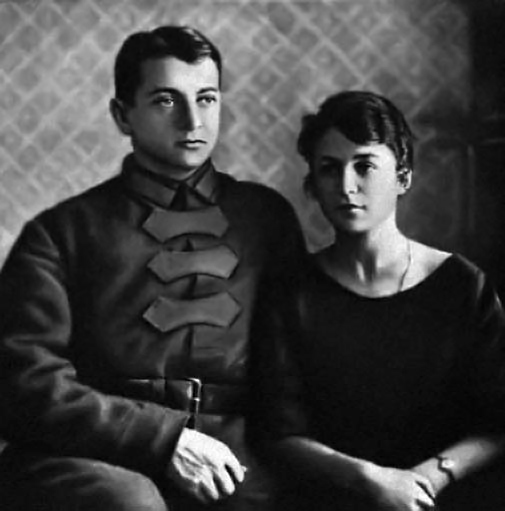
Stalin, unsatisfied with the torture and death of his General, directed the arrest of Mikhail’s mother, brothers, sisters and his beautiful wife, Nina. Later, he ordered the execution of Nina and Tukhachevsky’s brothers. His mother and one of his sisters died in prison. Three other sisters survived without their husbands, shot also. Mikhail and Nina’s daughter, underage at the time of his detention, suffered arrest when she attained her majority.
This was just the beginning, Stalin liquidated 3 out of 5 Marshals of the Soviet Union, 11 of 13 army commanders, 57 of the 85 corps commanders and 110 of the 195 division commanders as well as thousands of junior officers. The Red Army was under tremendous expansion, and it needed to dismiss a significant percentage of officers that did not have the qualities to command men in modern war or that were a hindrance for several reasons. The same happened in other States. For that reason, some voices insist that the purge in the Soviet Union did not affect markedly the Red Army efficacy.
It is probable that these opinions are wrong. One thing is to remove underperformers and other is to execute some of the brightest minds for political reasons. Not only the individuals disappear, but the doctrines associated with them lose weight, team-work suffers, and initiative and confidence to implement necessary changes diminishes dramatically in an environment of fear and self-preservation.
Before the 1941 assault, the Russian High Command obtained some factual evidence that something was wrong with their Army: during the 1939 invasion of Poland and the 1940 war against Finland the Red Army had a tremendous material advantage but fought clumsily. The offensive logistics were also badly coordinated (i.e. In Poland, despite of the relatively short distances involved, the Red Army was not able to advance with their full units and had to pool fuel to allow part of their forces to move ahead). Responsible commanders rapidly applied corrections but they proved insufficient, despite enjoying more than a year for full implementation.
Undoubtedly, the purges helped Stalin to strengthen his power and discourage opposition. During the whole war, the Soviet officers did not attempt at any time to kill or remove Stalin from power and displayed a remarkable loyalty. This continued to be the case even under the disastrous defeats of the first year and a half. However, the efficacy of the army suffered so badly, that surviving commanders found it difficult to lead large formations and within weeks of the invasion, Stavka found necessary to carry out a full-scale restructuring to simplify the field-unit structures allowing less experienced commanders to carry out their jobs.
Hitler, on the other hand, carried out his own mini purge in 1938, when he removed the Minister of Defense, Werner von Blomberg, and the Army Supreme Commander, Werner von Fritsch, along with other officers perceived as uncooperative. The Dictator did not kill or imprisoned any of them, or their families. Curiously, most historians have fiercely criticized this ouster as an example of Hitler’s ruthlessness and excess, but in comparison with Stalin’s, the Fuehrer’s effort was exceedingly timid. The Chief of Staff, Ludwig Beck remained in his post as well as Admiral Canaris, both of whom remained conspirators and sought to undermine Hitler at every opportunity. While the performance of the German army continued unaffected, he was incapable of attaining the same level of loyalty as Stalin did. The plotters inside Germany eventually became emboldened and a large faction of the Generals did their best to weaken the Head of State. Even when Beck quit his post, he continued to challenge the regime and he remained in close contact with Halder, his successor in the Army High Command, and many other unsupporting or outright treacherous elements within the Reich’s circles of power. The German High Command became a nest of conspirators unloyal to the Fuehrer. This unloyalty is a contributing factor of German defeat down the road, but its negative effect was not yet fundamental in 1941.
Both dictators failed to achieve the proper balance between military loyalty and efficacy and this translated in millions of deaths on each side. Stalin should have been less brutal and Hitler should have been more ruthless. In 1941 however, Stalin’s mistake had much more impact than Hitler’s.
Lastly, the Russians undervalued the competence of the German Army. They assumed complete ability to stop any German offensive before the Dnieper River and did not realize in its proper magnitude the one aspect that the Germans got especially right: the deployment of the most skillful army of modern times wielding an implacable method of waging operational war. Like the boxers that find themselves face to face in the ring to contest the championship fight, the real surprise for Stalin and his Generals was not so much that the Germans attacked or even the timing, but the obvious skill of their foe that translated into an amazing fighting power. This is clear when considering that in the 1942 campaign, the Germans once again demolished the Russian defenses despite significant numerical inferiority and that the Russians knew an attack was coming in Summer.
Stalin, for political reasons, needed to explain the enormous initial success of the Germans offensive (and consequently the enormous failure of the Soviet Government) and did so with the excuse of surprise. Although he meant to convince his uneducated populace, his argument also persuaded generations of historians.
Establishing the relative power of opposing military units is not a science though. Modern wargames do this all the time based on a study of what in fact, happened in the past. To plan their future actions, both Germans and Soviets established their estimates using objective and subjective data, but the Soviets proved less conservative in this case and were disturbingly surprised.
Stalin and the Soviet State, nevertheless, were better able to respond to their initial errors because of the Soviet Command structure. Stalin never occupied the position of Minister of War or Supreme Commander of the Army. He could select whoever he saw fit for those positions and he was sure he would do his utmost or risk his life. He could also immerse himself in important Army decisions or detach himself to analyze grand strategic matters. This allowed him to keep a Grand Strategic Vision during the War.
By Contrast, Hitler became de facto Minister of War when he occupied the post of Supreme Commander of the Armed Forces, forcing him to view the war from the Strategic (as opposed to Grand Strategic) vantage point. By the end of 1941 he would narrow his view even more when he occupied the position of Supreme Army Commander, thus narrowing his vantagepoint even more (to Strategic-Operational level). This factor had a disastrous impact in the conduct of the War on the German side, since the Fuhrer started a trend to spend scarce time controlling army operations in lieu of more decisive problems.